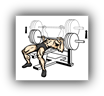
The bench press is decent exercises but sometimes people put too much emphasis on it and end up with shoulders problems and ugly postures. All of this is caused by muscle imbalances and bad form. The bench press makes your pectoralis major very strong but the external shoulder rotators (infraspinatus, posterior deltoids and teres minor) will remain weak unless special attention is paid to them.
How do you balance out the bench press? Pull-up? Barbell Rows?
The latissimus dorsi or the largest upper body muscle is also an internal shoulder rotator. In other words big lats can still be a problem and will not balance out all the pressing. That's why pull-ups are not the best counter to the bench press.
In order to balance the shoulder girdle the upper back is key. The traps, rhomboids, posterior deltoids and other small muscles of the upper back have to be trained. Happily the barbell row does exactly that. However make sure that you use a wider grip when doing barbell row specifically for upper back.
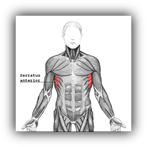
This is not the end of it all. There is still more to balance. Believe it or not but according to many experts the famous rotator cuff shoulder injuries are usually caused by weak scapula stabilizers. That's why barbell rows won't be enough to balance out everything because one major muscle stabalizer fails to receive stimulation during bench presses AND rows - the serratus anterior or the boxing muscle. The main function of the serratus is to protract the scapula or in other words to pull your shoulders forward. Weak and/or inactive serratus is the main cause of winged scapula postures.
In order to protect the shoulder during bench presses people usually retract the scapula during the whole movement. Upper back and latissimus dorsi contraction stabilize the shoulder and prevent any kind of unwanted movement during the exercise. This is great for lifting a lot of weight and preventing injury but the scapula is not moving. When the scapula is not allowed to move naturally the muscles supporting it are not going to get stronger and the whole thing will become rather imbalanced and impingement may be developed.
The overhead press will strengthen not only the major scapular stabilizers but it will do the same for each muscle of the rotator cuff in isometric fashion. In other words the full range of motion and strict form overhead press makes the silly rotator cuff exercises done with the pink dumbbells a complete waste of time. However the overhead press is still a front deltoid dominant exercise and you still need rows for the rear delts middle traps, rhomboids...etc.
Conclusion: You need to do two exercises in order to prevent shoulder problems caused by bench press training - overhead presses and various form of rows. If you do those two exercises chances of injuring your shoulder because of muscle imbalances are close to zero. There simply won't be a weak link.
The solution - the overhead press and scapular push-ups.
During an overhead press the serratus anterior rotates the scapula upwards while the scapular push-ups in the video below hit it directly without much involvement from other muscle groups. Unless you have current shoulder problems and winging scapula you may skip the scapular push-ups and stick to overhead presses.